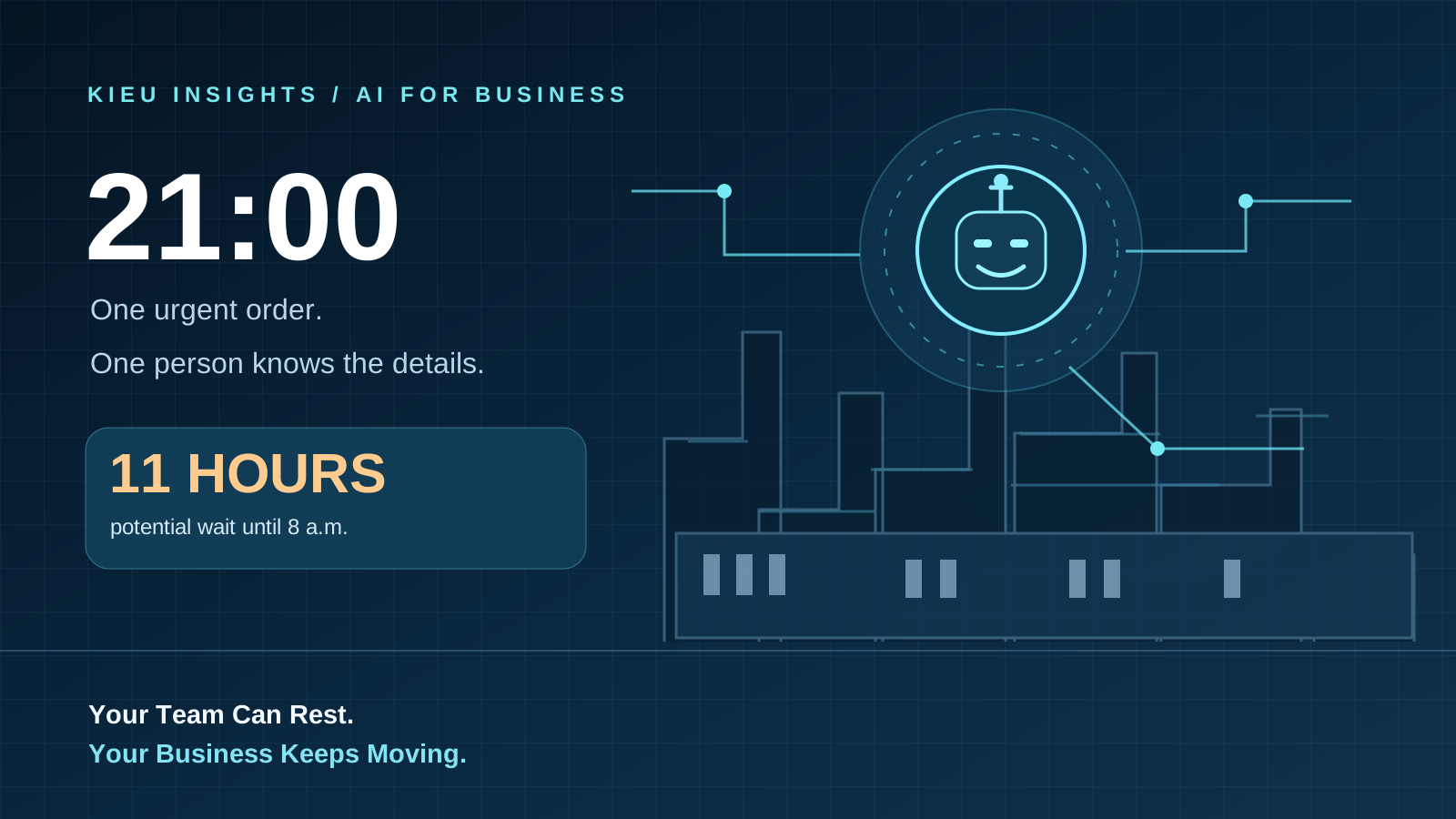
More than 100 employees. An industrial-chemical supplier serving factories that run around the clock. An urgent request at 9 p.m. But the one person who knows the order details has finished work. What happens when critical business knowledge is accessible through only one employee?
Source note: This article examines a scenario presented by Vietnam's VTV24 in Hết giờ là hết việc?, published on 30 July 2026. The AI Employee workflow below is a proposed solution, not an AI system documented as deployed at the company in the report.
9 p.m.: An urgent chemical delivery request
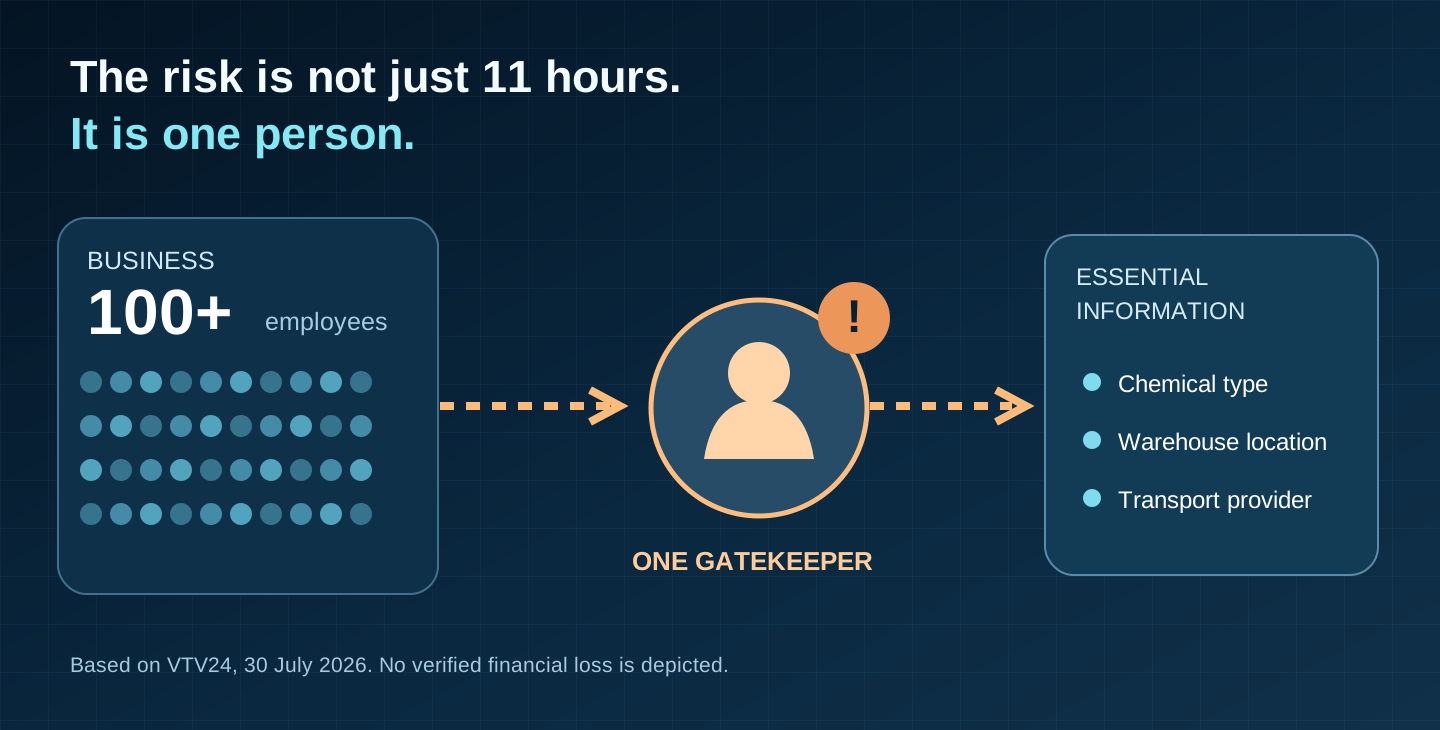
According to VTV24, Vu Anh Tuan's company in Ho Chi Minh City employs more than 100 people and supplies industrial chemicals to factories. Many of its customers' factories operate production lines 24 hours a day.
At approximately 9 p.m., a customer discovered a chemical shortage caused by an oversight during an inventory check. The customer posted in a shared group, acknowledged its mistake, requested an urgent delivery and agreed to cover all additional costs.
Messages kept arriving, but the employee responsible for the order did not respond. That employee was the person who held the critical details: the chemical type, warehouse location and transport provider.
The team leader called directly. The employee explained that the working day had ended, both the work computer and phone had been left at the office, and the issue would be handled at 8 a.m. the following morning.
From 9 p.m. to 8 a.m. is a potential 11-hour wait.
There is an important distinction: VTV24 did not report a verified financial loss or establish that a production line had stopped for the entire 11 hours. The story illustrates the risk of operational delay when vital information cannot be accessed.
The real problem is not an employee declining an after-hours call
Employees need time away from work, subject to any appropriately agreed on-call arrangements. Businesses also need a way to handle genuine emergencies.
Those needs do not have to be in conflict.
The weakness is how operational knowledge is recorded, shared and handed over. If every detail needed to fulfil an urgent order resides with one individual, the organisation is exposed whenever that employee finishes a shift, takes leave, moves teams or leaves the business.
A company supporting round-the-clock operations does not need every employee online 24/7. It needs reliable information, clearly defined permissions, an on-call roster and an accountable escalation process.
What if the business had an AI Employee?
Return to 9 p.m., this time in a hypothetical implementation.
A team leader asks an authorised AI Employee:
"The customer needs an emergency chemical delivery. Check the related order, product specification, warehouse location and transport options. Then pass the information to the person on duty."
If the company's systems contain accurate, current data, AI could help the team:
- Find orders and product information: retrieve customer requirements, chemical specifications and delivery instructions from approved sources.
- Check inventory: read stock records, show their sources and timestamps, and flag uncertain information.
- Prepare transport options: consult approved carriers and emergency procedures without asserting that a truck or driver is available until confirmed.
- Escalate to the right person: give the on-call team a concise handover supported by records.
- Keep an audit trail: record the request, data used, approvals and completed actions.
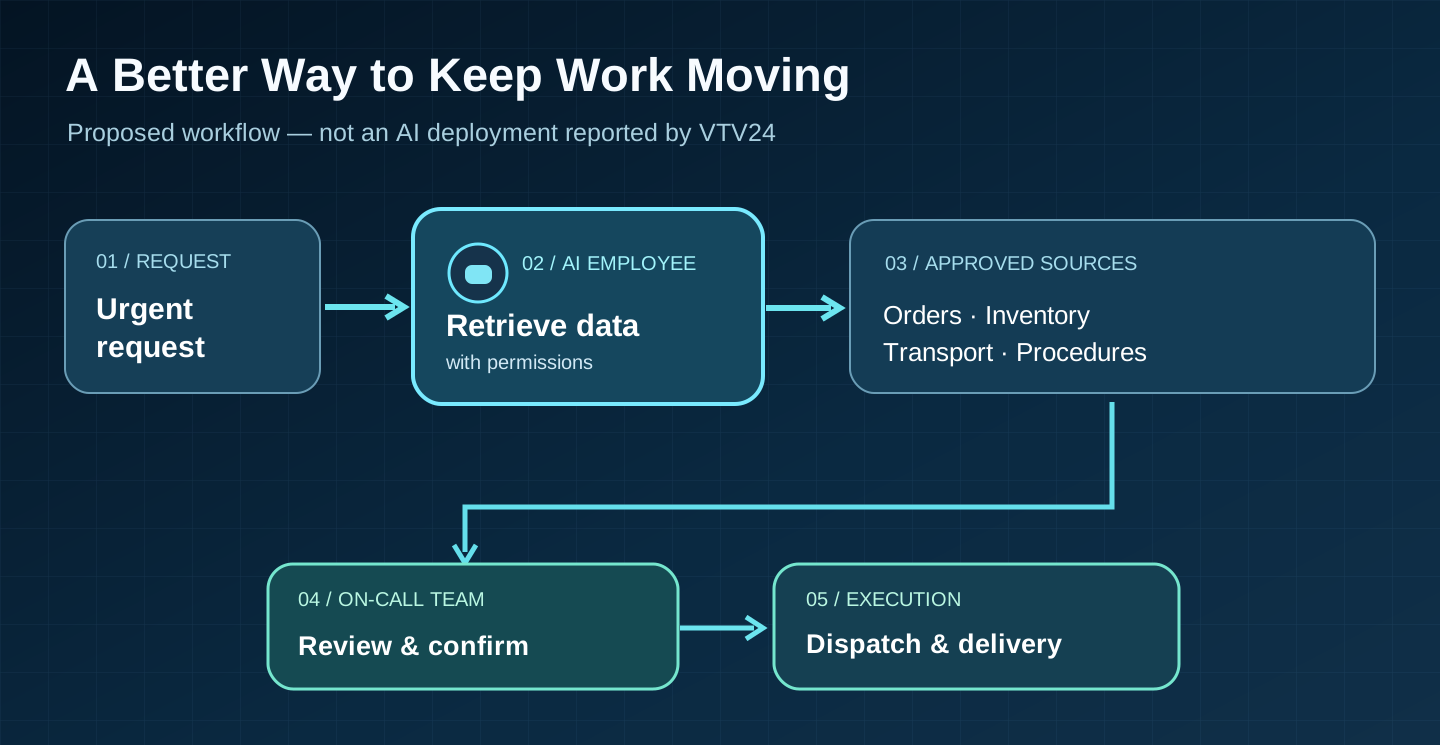
AI cannot create inventory, guarantee transport capacity or make every decision for a human operator. It becomes valuable when trustworthy data, role-based access and clear business processes are already in place.
How is an AI Employee different from a chatbot?
A conventional chatbot often focuses on answering questions. A business AI Employee must also understand its role, approved sources, permissions, workflows and handover obligations.
An AI Sales Assistant might look up prices and order status. An AI Inventory Assistant might locate stock and surface discrepancies. An AI Operations Assistant might assemble incident details and prepare an escalation for the designated decision-maker.
The goal is not to remove people from the workflow. It is to make sure business information doesn't disappear from the workflow when one employee disconnects.
How much could an 11-hour delay cost?
The video does not provide enough information to calculate that amount.
An evidence-based return-on-investment assessment requires the business's own data: actual response delays, after-hours request volumes, confirmed production downtime if any, additional freight costs, affected order value and the share of requests an AI-assisted workflow can safely resolve.
A pilot can measure time to retrieve complete information, time to hand over to the on-call team and the percentage of requests handled in line with policy before and after implementation.
This is how to build a verifiable business case instead of inventing a savings figure.
Your Team Can Rest. Your Business Keeps Moving.
A company serving customers 24/7 should not require every employee to work 24/7.
At KieuGroup, our vision for Kieu AI Employee is to build role-specific AI assistants that can access authorised business knowledge and processes, helping teams continue work when the usual knowledge holder is unavailable.
Don't design a business that only works when one particular employee is online. Design one where reliable information reaches the right authorised person at the right time.
Explore the Kieu Factory vision →
Discuss AI opportunities for your business →
Source: VTV24 — Hết giờ là hết việc?, published 30 July 2026. The 9 p.m./8 a.m. times, company size, industrial-chemical supply business and customers' 24/7 operations are described around 00:00–02:43 and 26:16–27:39. All images are KieuGroup concept illustrations, not footage or photographs of the reported incident.